


 03 9070 5784
 Help & Support
 Track My Order




Recently Viewed
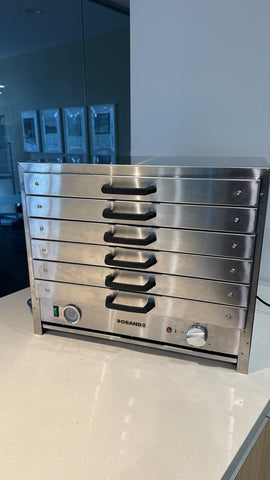

 Stainless Steel Design Pie Warmer (CL-80DT-3657)
585(W) X 350(D) X 485(H)mm
Refurbished commercial food warmers cover everything that keeps cooked food at temperature without cooking it further: chip warmers over a fryer, soup kettles on a counter, sauce warmers, heat lamps over a pass and holding cabinets behind it. Refurbished food warmers are an easy place to save, because the machines are simple and they last. The new range starts at commercial chip warmers and commercial soup kettles.
Stock comes off showroom floors, out of demonstration kitchens and off supplier clearance lines. Each unit is inspected, tested and verified in working condition before it is relisted for sale, and the marks it carries are described on its own product page.
Match the warmer to the food. Fried product wants dry heat and airflow; soup and sauce want a wet well; plated food under a pass wants radiant heat from above, which is what commercial heat lamps do. For pans of food at a service counter, a refurbished bain marie is the better tool.
Tell us what you need to hold and get a quote on the warmers in stock this week — nearly every unit here is a single machine, so the list keeps changing. Related ranges: refurbished commercial kitchen appliances, commercial holding cabinets and commercial sauce warmers and dispensers.
A bain marie is one kind of food warmer — a well, wet or dry, that holds gastronorm pans at a service counter. The wider category includes machines that are shaped for a specific food rather than for pans: chip scuttles with a lamp and a mesh base, soup kettles with a round well, hot dog and sauce units, and heat lamps that hold plated food at a pass.
Pick by the food, not by the name. Pans of wet food belong in a bain marie. Chips belong in something with a mesh base and airflow, because chips held in a sealed well steam themselves soft within minutes.
For a while, and only in the right unit. Fried product goes soft when its own steam has nowhere to go, so a chip warmer sits the product on a mesh or slotted base, lets the steam escape and warms from above. Put the same chips in a closed well and they are ruined in minutes.
The other half is time. Nothing holds fried food indefinitely. Keep batches small, keep the lamp on and the base clear, and cook to demand rather than filling the warmer at the start of a rush. If chips are a core line, a dedicated chip warmer beside the fryer earns its place.
That is set by your food-safety plan and by the temperature the food is actually holding at, not by the machine, so work from your own procedures and keep a probe thermometer at the station. The machine's job is to hold; the clock is yours to manage.
Two practical points. Food must go in already hot, because a warmer cannot bring cold product up safely. And the temperature that matters is in the food, not on the dial — a well set high with a deep pan in it can still have cool product in the middle.
The element and the thermostat, the condition of the well or the base, and the power lead and plug. These are simple machines, so most faults are at the cheap end — an element, a thermostat, a switch, a lamp holder — provided parts for the model are still available.
Then scale and pitting in any wet well, which tells you about the water and the cleaning it has had. Ask us what was replaced during the refurbishment rather than what was looked at, and ask about parts for the exact model if the unit is older or an unfamiliar brand.
It can, because a heated unit draws steady power rather than cycling the way refrigeration does. The requirement for each unit is on its product page, and some need a 15 amp outlet, which has a wider earth pin and will not take a standard plug until an electrician fits one.
Add up what is already on the circuit before you plug a warmer in beside a toaster, a sandwich press and a till. It is the counter circuit that trips, not the machine that fails, and the fix is an electrician rather than a different warmer.
A heat lamp over a pass is holding plated food rather than cooking it, so it is not the appliance that drives a canopy requirement — the cooking line underneath it is. What matters is that the lamp is not mounted where it fights the extraction or sits in the path of the air being pulled off the cooktops.
Mount it at a height that warms the plates without cooking the garnish, and keep the pass itself clear. If the pass is being rebuilt, sort the exhaust hood and the lamp position together rather than one after the other.

We have a special page just for stock that's warehoused in Perth.
Click Here to see all WA stockWhat our customers say about us on Google, and how Google scores our store for things like shipping and returns.
Store scores from Google