


 03 9070 5784
 Help & Support
 Track My Order




Recently Viewed
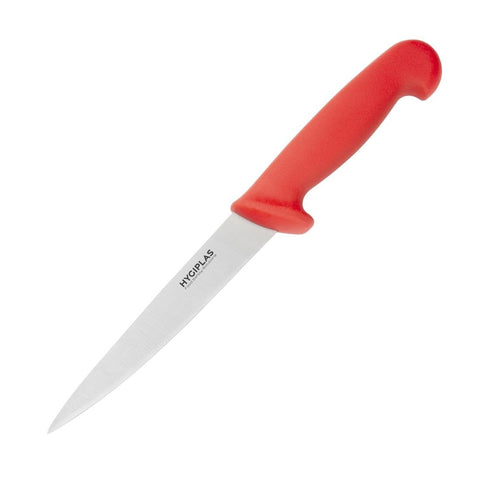

 Hygiplas Fillet Knife Red 160mm - C889
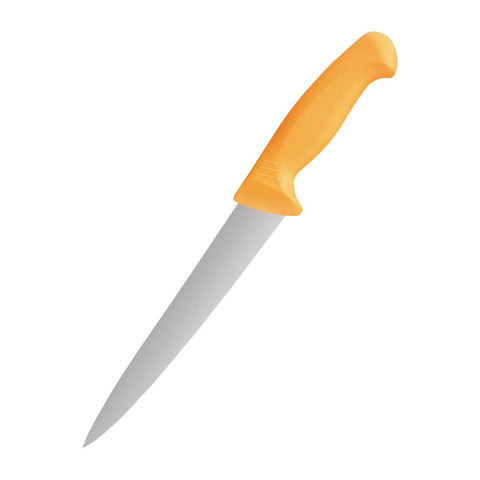

 Vogue Pro Flexible Fillet Knife 20cm - GH525
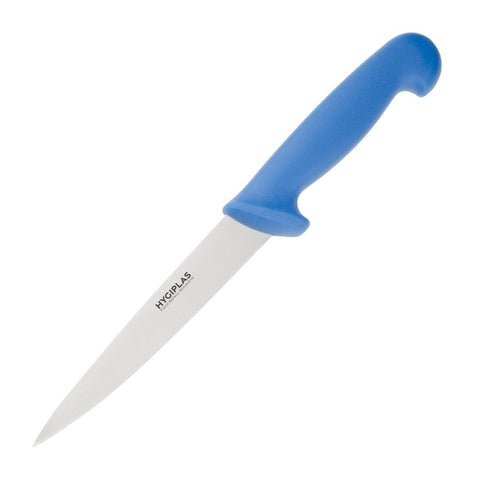
 Hygiplas Fillet Knife Blue 150mm - C853
A fillet knife takes the flesh off a fish and leaves the frame behind, because a flexible blade follows the contour of a rib cage or a skin line. That yield difference is the whole reason the tool exists, and flex is what fillet knives are chosen on.
Commercial fillet knives come in two broad flexes. A very flexible thin blade suits delicate fish and skinning; a stiffer blade suits larger fish and boning meat, where you need to push against bone without the blade folding. Professional fish filleting knives sit at the flexible end.
A commercial fish fillet knife is also a safety item, because it is used with the hand close to the blade. A grippy handle that works with wet, cold, oily hands matters more here than on any other knife in the kitchen.
Still working out which flexes and lengths your section needs? Ask for the price guide and compare the fillet knives against the boards and steels you would buy with them.
Match it to the biggest thing you fillet. Thin flexible blades are excellent on flathead, snapper and salmon sides and poor on anything that needs force. A semi-flexible blade is the safer single choice for a mixed section.
If you butcher as well as fillet, buy two: one flexible for fish, one stiffer boning blade from the commercial knives range for meat.
Closely related and not identical. A boning knife is usually stiffer and shorter with a sharper point, designed to work around joints; a fillet knife is longer and more flexible, designed to run along a flat plane.
Kitchens that break down whole animals want both. A seafood-only section needs only the fillet blade and a pair of kitchen scissors.
Long enough to run the length of the fillet in one stroke. Short blades mean multiple passes and ragged flesh, long blades are unwieldy on small fish.
Most sections hold two lengths. Lengths are listed per product, and specifications explains how we present them.
Hand blades give control and yield; electric knives are faster on repetitive work with uniform fish. In a restaurant the hand blade wins because the fish vary.
At processing volume, equipment changes the maths — a meat slicer and the equipment in the meat processing range handle portioning more consistently than any knife.
A board with grip and a lip or channel, because filleting releases a lot of liquid. A colour-coded board kept for seafood only, from the chopping board range, avoids the obvious cross-contamination.
Wet a cloth under the board so it does not slide. A board that moves while a flexible blade is in a fish is how people get cut.
Carefully and at a shallow angle, with the blade supported so it does not bend away from the stone. A flexible blade on a powered grinder is easy to ruin.
A fine steel for daily honing and a stone or a service for re-grinding. The sharpeners range covers what suits a thin blade.
Hand washed, dried straight away, and stored with the edge protected. Fish oil and salt are corrosive, so a blade left wet marks even in stainless.
Keep it in a knife case or on a rack rather than in a drawer. If it is used at a seafood display or a bench out front, it needs a guard.
In a seafood section, yes. Salt and acid go to work on carbon steel quickly, and a rusting blade in a wet environment is not worth the edge retention.
304 stainless steel is the food-safety grade used in Australian commercial kitchens, and a harder stainless alloy will hold a fine edge well enough for filleting.

We have a special page just for stock that's warehoused in Perth.
Click Here to see all WA stockWhat our customers say about us on Google, and how Google scores our store for things like shipping and returns.
Store scores from Google